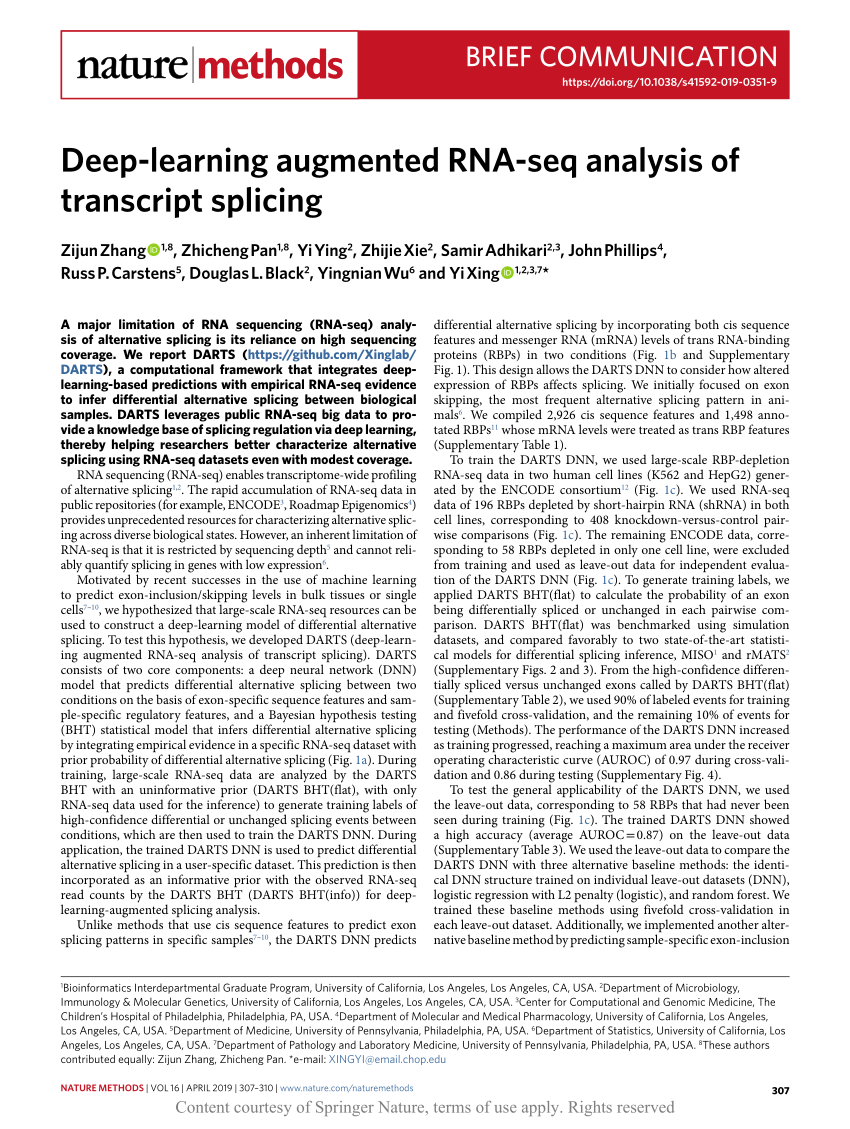
Ultra deep rna sequencing has become a powerful approach for genome wide analysis of pre mrna alternative splicing.
Multivariate analysis of transcript splicing mats r package.
Here we report a new statistical model and computer program replicate mats rmats designed for analysis of replicate rna seq data.
R is a statistical computing environment that is powerful exible and in addition has excellent graphical facilities.
We develop a statistical framework that uses a distance based approach to compute the variability of splicing ratios across observations and a non parametric analogue to multivariate analysis of variance.
Method of the pack is based on latent negative binomial gaussian mixture model.
Out using the same package.
We implement this approach in the r package.
The statistical model of mats calculates the p value and false discovery rate that the difference in the isoform ratio of a gene between two conditions exceeds a given user defined threshold.
Maptest provides a general testing framework for differential expression analysis of rna seq time course experiment.
We develop mats multivariate analysis of transcript splicing a bayesian statistical framework for flexible hypothesis testing of differential alternative splicing patterns on rna seq data.
It is for these reasons that it is the use of r for multivariate analysis that is illustrated in this book.
Ultra deep rna sequencing has become a powerful approach for genome wide analysis of pre mrna alternative splicing.
We previously developed multivariate analysis of transcript splicing mats a method for detecting differential alternative splicing between two rna seq samples.
A major application of rna seq is to detect differential alternative splicing i e differences in exon splicing patterns among different biological conditions.
In this book we concentrate on what might be termed the core or clas.
We are planning to support various read length in the future.
Meanwhile users can use trimfastq py tool included in the mats package to trim the reads to the same length.
We develop mats multivariate analysis of transcript splicing a bayesian statistical framework for flexible hypothesis testing of differential alternative splicing patterns on rna seq data.
We recently developed a statistical method multivariate analysis of transcript splicing mats for detecting differential alternative splicing events from rna seq data.
The proposed test is optimal in the maximum average power.
Mats currently requires all the read lengths to be the same.
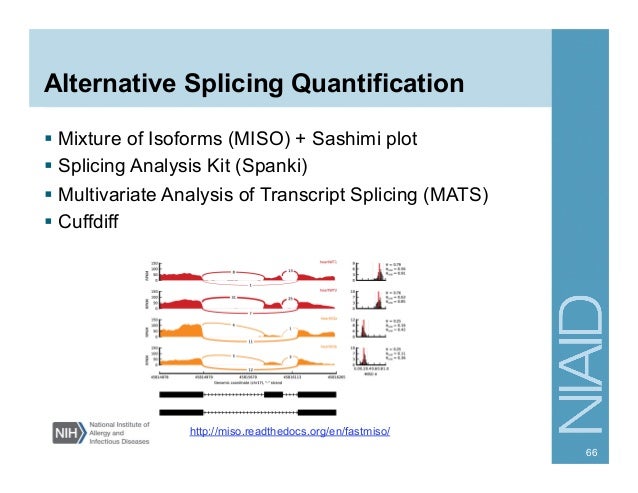
Mats is a computational tool to detect differential alternative splicing events from rna seq data.